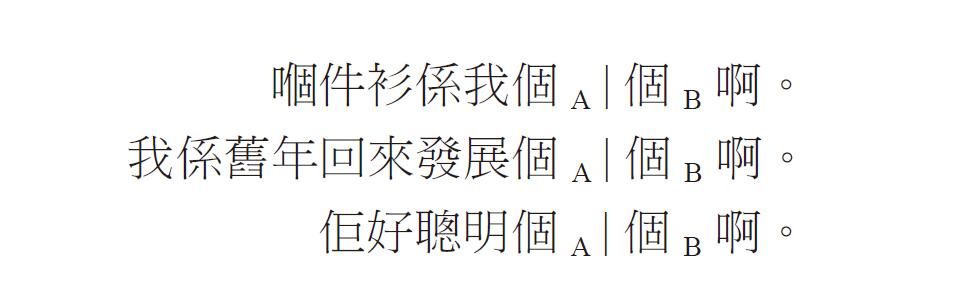
The syntactic function of the sentence-final de has been widely discussed in the academic circles. In the Lianjiang and Maoming dialects of western Guangdong, the corresponding form of the sentence-final de is ge [kɔ33], which is equivalent to de3 in Mandarin and highly parrallels de3 in development trajectory. The [kɔ] at the end of a sentence in the dialects of western Guangdong has a dual nature. It can be analyzed as a structural particle while conveying a broad confirmation tone. When expressing assertion and confirmation, two [kɔ]s can appear at the end of the sentence, representing an intermediate stage in the evolution of [kɔ] from a structural particle to a modal particle. The co-occurrence phenomenon exists not only in the Cantonese dialects of western Guangdong but also in the Hakka dialect of Anyuan (Kongtian) in Jiangxi. This dialectal fact confirms the evolution process of “structural particles>modal particles” and provides important clues for the discussion of Mandarin de and other related issues.
Key words
final structural particle de /
modal particles /
co-occurrence
{{custom_sec.title}}
{{custom_sec.title}}
{{custom_sec.content}}
References
曹道根、包琳玲. 2018.“的”的語氣詞歸屬問題和漢語分裂句的傳信功能.中國語言學報 18.32-51.Daogen Cao & Linling Bao. 2018. “De” de yuqici guishu wenti he Hanyu fenlieju de chuanxin gongneng.Journal of Chinese Linguistics 18. 32-51.
飯田真紀. 2017.粵語句末助詞“嘅”ge2 的語義和語法化途徑.中國語文 4.421-437, 511.Maki Iida. 2017. Yueyu jumo zhuci “ge” (ge2) de yuyi he yufahua tujing.Zhongguo Yuwen 4. 421-437, 511.
范曉蕾. 2017.基於漢語方言的慣常範疇研究.當代語言學 4.561-590.Xiaolei Fan. 2017. Jiyu Hanyu fangyan de guanchang fanchou yanjiu.Dangdai Yuyanxue 4. 561-590.
范曉蕾. 2024.句末助詞“的”的功能分類及語義演變.漢語學報 2.2-14.Xiaolei Fan. 2024. Jumozhuci “de” de gongneng fenlei ji yuyi yanbian.Hanyu Xuebao 2. 2-14.
柯淑玲. 2025.潮安方言的情態動詞——兼論確存情態及“存在”義的演變.中山大學博士學位論文.Shuling Ke. 2025. Chao’an fangyan de qingtai dongci: Jian lun quecun qingtai ji “cunzai” yi de yanbian. Zhongshan Daxue boshi xuewei lunwen.
李訥、安珊笛、張伯江. 1998.從話語角度論證語氣詞“的”.中國語文 2.93-102.Charles N. Li, Sandra A.Thompson & Bojiang Zhang. 1998. Cong huayu jiaodu lunzheng yuqici “de”.Zhongguo Yuwen 2. 93-102.
林華勇. 2015.廣東廉江粵語的傳信語氣助詞.語言科學 4.405-416.Huayong Lin. 2015. Guangdong Lianjiang Yueyu de chuanxin yuqi zhuci.Yuyan Kexue 4. 405-416.
劉瑩、程工. 2021.從焦點的類型看“的”字結構的語義.中國語文 1.28-42, 126-127.Ying Liu & Gong Cheng. 2021. Cong jiaodian de leixing kan “de”zi jiegou de yuyi. Zhongguo Yuwen 1. 28-42, 126-127.
馬學良、史有為. 1982.說“哪兒上的”及其“的”.語言研究 1.60-70.Xueliang Ma & Youwei Shi. 1982. Shuo “nar shang de” ji qi “de”.Yuyan Yanjiu 1. 60-70.
盛益民. 2021.吳語紹興(柯橋)方言參考語法.北京:商務印書館.Yimin Sheng. 2021. Wuyu Shaoxing (Keqiao) Fangyan Cankao Yufa. Beijing: Shangwu Yinshuguan.
施其生. 2009.漢語方言中語言成分的同質兼併.語言研究 2.104-113.Qisheng Shi. 2009. Hanyu fangyan zhong yuyan chengfen de tongzhi jianbing.Yuyan Yanjiu 2. 104-113.
完權. 2013.事態句中的“的”.中國語文 1.51-61, 96.Quan Wan. 2013. Shitaiju zhong de “de”.Zhongguo Yuwen 1. 51-61, 96.
袁毓林. 2003.從焦點理論看句尾“的”的句法語義功能.中國語文 1.3-16, 95.Yulin Yuan. 2003. Cong jiaodian lilun kan juwei “de” de jufa yuyi gongneng.Zhongguo Yuwen 1. 3-16, 95.
朱德熙. 1961.說“的”.中國語文 12.1-15.Dexi Zhu. 1961. Shuo “de”.Zhongguo Yuwen 12. 1-15.
 PDF(703 KB)